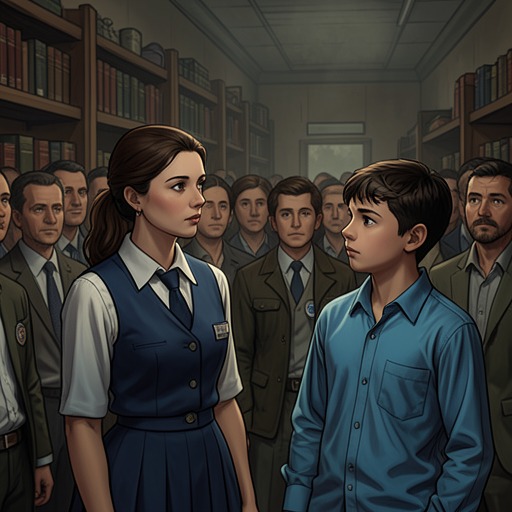
Kanae Sumida
5 Centimeters per SecondKanae Sumida is a high-school student on Tanegashima whose youthful life is shaped by two efforts that repeatedly meet resistance: learning to surf and trying to tell Takaki Tohno she loves him. Seen first through her own perspective, she is exhilarated by the sea, embarrassed by her awkwardness, and keenly aware that the time she has left with Takaki is running out. Years later, Takaki’s recollection gives her story a second measure: the girl who could not speak her confession proves, in their final farewell, stronger and more mature than he is.
Identity and Background
Kanae’s feelings for Takaki began when he transferred to Tanegashima from Tokyo in the spring of their second year of middle school. At the opening ceremony, the new student stood calmly before the blackboard, smiling without visible nervousness. He introduced himself in a composed, clear voice and spoke standard Japanese, a contrast to the island setting that made him seem to Kanae almost like someone from television. She wondered about the life and character behind his confident manner; as she later understands it, she had fallen in love at that first sight.
By high school, Kanae and Takaki are in different classes, but she remains attached to him. Her affection is not a passing crush: she has loved him for five years. The approaching end of their school days gives that long-held feeling a deadline. With only the six months before graduation left to spend with Takaki, the ordinary passage of time carries the pressure of an impending separation, even before she has managed to tell him what she feels.
The Sea and the Life She Has Not Chosen
Kanae’s account opens in the water, under a low morning sun whose glare scatters across the sea. Floating in the warmth, she feels nearly weightless and briefly fortunate, despite knowing she has plenty of problems. She paddles toward another wave, captivated by its shifting colors and gradual rise, and tries to make her board skim across it. When she attempts to stand, she loses her balance and tumbles beneath the wave; seawater stings the backs of her eyes. The scene establishes both her delight in surfing and the gap between that delight and her progress: in the preceding six months, she has not successfully caught a single wave.
Her uncertainty reaches beyond the surf. At morning homeroom, the teacher distributes a third future-course survey and tells the students to discuss their choices with their families. Kanae has no idea what to write. At lunch, while her classmates talk about future courses, she eats the sweet rolled omelet her mother packed and tries, without success, to recall the name of the classical piece playing in the classroom. The juxtaposition is characteristic of her situation: she can be absorbed in immediate sensations and pleasures, yet the decisions ahead remain unresolved.
Her feelings also register physically before she can make them into words. Riding home behind Takaki on a narrow road between sugarcane fields, she watches him ahead and feels warmth deep in her chest and a twinge at the back of her nose, like the sensation after a surfing wipeout. Happiness and sadness seem strangely close. The image links her emotional attachment to the bodily vulnerability already present in her surfing: both draw her toward something she wants, while leaving her exposed to failure or loss.
Takaki and the Unspoken Confession
A brief exchange with Takaki leaves Kanae flustered and happy enough to run off. She hears his kind voice behind her as he says goodbye, and her reaction makes plain how much even a small moment with him matters. Yet she is frustrated by her inability to think or behave with greater sophistication. Her private joy is intense, but she wants to keep it from showing too plainly.
When Kanae finally approaches the possibility of confessing, she cannot get the words out. Takaki asks what is wrong; his voice is quiet, kind, and cold, and his determined expression makes the limit of the moment unmistakable. Kanae experiences his response as a firm rejection of the confession before it can be spoken. The cicadas continue calling across the island as the two make their way home in the fading light. The scene’s central turn is not a declaration but its absence: the feeling has become visible between them, while the words that might have named it remain unsaid.
Takaki’s later memory clarifies the imbalance without reducing Kanae to the rejected admirer. He recognizes why she had been drawn to him and recalls the moment she tried to tell him she loved him, as well as his own decision not to let her say it. He understands what happened with sharp clarity, but says in retrospect that he could not act otherwise. For Kanae, the result is a confession that never becomes a spoken exchange; for Takaki, it becomes a memory he still associates with a slight ache.
Departure and Retrospective Significance
At seventeen, Kanae stands beside Takaki at his first rocket launch. A decade later, he remembers her as a cute, lively girl, deeply tanned from surfing, and finds that thoughts of her still hurt a little. The recollection brings back not only her appearance and voice but the colors, sounds, and smells of the island where they spent their adolescence. The launch marks a vivid point in their shared past, but it does not resolve the relationship: the emotional clarity Takaki felt then did not give him the ability to answer Kanae’s feelings.
When Takaki leaves for Tokyo to attend university, he shares his departure time with only Kanae. They meet in the parking lot of the small airport, which resembles a ferry terminal, and exchange a few final words as their conversation repeatedly trails off. Kanae cries throughout their goodbye, yet smiles when they part. In Takaki’s later assessment, she is already far stronger and more mature than he is. That judgment complicates the earlier image of a girl unable to speak: Kanae’s confession fails, but her final gesture of farewell is her own. Her story rests in that contrast between what she cannot say and the composure she manages to offer when separation becomes real.